
Remember first to always ask "what is your why". Why do you do what you do? Also come back to this. If the micro doesn't fit the macro there's divergence. If this is with stocks, your professional or personal life. Stay focused and stay true.
Theme of Q1
Trending away from Tech and going towards defensives, pharma, dividends, and cyclical. Classic safety plays.


Large Cycles

Major Macro Events
Warsh Fed Chair Nomination. The Catalyst That Canceled The Gold/Silver Trade
You boarded up your windows for a 'Hurricane' that you think is coming but it just got canceled. Everyone bought gold to hide from inflation. But the new Fed pick, Kevin Warsh, the market believes, will stay true to his hawkish ways, regardless of what he is saying now. Therefor the market is ripping the boards off and dumping the gold/silver. The 'panic trade' is over."
Keep this in mind. "Structural Hawk" (small Fed) but a "Cyclical Dove" (he wants lower rates to spur growth/AI productivity). He wants to trade a "Big Fed" for "Cheap Money."
Old vs New Warsh
2006 - Warsh joins the Fed Board of Governors at 35, the youngest ever, walks right into the GFC, and he was hawkish. Ben Bernanke wanted mega stimulus (remember QE aka Quantitative Easing), while Warsh wanted high rates to avoid inflation. Then it's often cited that he 'resigned in protest' in 2011 of what the Fed was doing, aka Ben Bernanke’s QE.
2025 - Warsh says AI productivity boom is a supply side miracle (supply and demand), so AI is a deflationary force. He thinks AI will make everything cheaper. Said "Double standard of living in one generation". Wants a smaller fed, shrink the balance sheet, Scott Bessent, the Treasury Secretary.
Skeptics
Philip Jefferson, the vice chair, doesn't agree. He gave a speech last year in Germany, stating that AI will drive price inflation due to the costly build-out. Comes down to a mix in short/long term deflationary results. When will the AI price deflation happen?
Market Reaction
The Gold & Silver crash was basically a "reverse relief rally" since Warsh is seen as a Historical Hawk, which means he might cut rates a bit if needed, but he's not going to cause runaway inflation due to being overly dovish. Being a "dove" is just something he's masquerading as to get elected, or so that's the consensus. Surging dollar proves it.
It's like you boarded up your windows for a big hurricane (buy gold & silver) and now you realize there's no hurricane. That's why it could be considered a "reverse relief rally": people dumped assets that typically perform well in times of uncertainty.
Current Situation
Senator Tillis says he will block all Fed chair nominees until the DOJ is done with the investigation into Jerome Powell. It’s officially about alleged false statements to Congress regarding the $2.5 billion renovation of the Fed’s headquarters (the Eccles and Martin buildings). Powell and his supporters call this a "political hit job" to force him out before his term ends in May. Powell's term is up in May. If the DOJ thing drags on, Powell stays until a new Fed chair can be elected.
The current Federal Open Market Committee (FOMC) had only 2 of 12 members who wanted cuts. Even if Warsh is elected, he wouldn't be able to enact the "new Warsh policies" because he would be just one vote. However, the Chair has "agenda-setting" power. If Warsh becomes Chair, he controls what the committee votes on. He doesn't need to win a 12-0 vote; he just needs to move the "center of gravity."
The market still expects the old Warsh to show up on the first day of work (if everything goes to plan and he is elected).
Next Steps
1. The "Double Confirmation" Gauntlet
Because Warsh is not currently on the Board, he has to be confirmed twice: once to join the Board of Governors (filling the seat of Stephen Miran) and once to be elevated to Chair. This gives Senator Tillis and the Democrats two chances to grill him.
2. The DOJ "Renovation" Probe
Watch for the DOJ to either "put up or shut up" by March. If they issue a formal indictment against Powell, it would be unprecedented. If they don't, Tillis may eventually cave or find a compromise.
3. The May 2026 "Ghost Chair" Scenario
If Warsh isn't confirmed by May when Powell’s term as Chair expires:
Powell stays on the Board: His term as a Governor doesn't expire until 2028.
The Vice Chair Takes Over: Philip Jefferson (the AI skeptic) would likely become "Acting Chair." This would be the ultimate irony: Trump’s move to get "New Warsh" (dovish) could result in Jefferson (more cautious/hawkish) running the show.
4. The Balance Sheet Pivot
Warsh’s most "Old Warsh" trait is his obsession with shrinking the Fed’s balance sheet. Watch for him to propose a "trade": he will offer the White House lower interest rates in exchange for faster Quantitative Tightening (QT). He wants a "smaller Fed" that doesn't own trillions in bonds.
Stock Earnings & Analysis
Large Caps
$PYPL - earnings in line with our expectations, but the market over-reacted more than we expected. Does anyone use paypal anymore?
$GOOG - Earnings: $403 billion in sales in 2025, capital expenditures could hit $185 billion this year (double its 2025 spend).
$GOOS - Q3 saw 13% revenue growth, led by strong D2C (Direct 2 Consumer) and wholesale gains in North America and Asia Pacific. Adjusted EBIT margin contracted due to higher SG&A (Selling, General, and Administrative) and product mix, but margin expansion initiatives are underway for fiscal 2027.
$COIN - https://www.tradejournal.co/post/coinbase-going-from-stock-dilution-to-buy-backs/
Small Caps
2/10
$PHIO - 55% 9m float - Phase 1b news
$ABP - 65% 1.7m float - 7% stake Goldman
$EVMN - 7% 18m float - Phase 2a Trial Eczema
Appendix
Macro-Economic Phenomena
Concepts that describe specific market "vibes" or historical shifts.
- Stagflation: A punishing combination of stagnant economic growth, high unemployment, and high inflation. It defies the traditional Phillips Curve logic that inflation and unemployment move in opposite directions.
- The "Lost Decade": Originally referring to Japan’s economic stagnation in the 1990s following a massive real estate bubble burst; now used to describe any long period of zero-to-negative real returns in an asset class.
- Reflation Trade: A bet that the economy is about to accelerate after a slump, usually characterized by rising interest rates, a steeper yield curve, and outperformance in "cyclical" stocks (banks, energy, industrials).
Geopolitical & Policy Landmarks
These terms serve as historical anchors for how the global monetary system was reshaped.
- End of Bretton Woods (1971): The moment President Nixon ended the convertibility of the US Dollar to gold. This shifted the world from a fixed exchange rate system to the floating fiat system we use today, introducing significant currency volatility.
- Plaza Accord (1985): An agreement between the G5 nations to depreciate the US Dollar against the Japanese Yen and German Mark. It was successful but is often blamed for fueling the Japanese asset bubble that followed.
- America First / Protectionism: Policy shifts focused on domestic production, tariffs, and deglobalization. For a fund, this usually signals a shift in supply chain dynamics and potential inflationary pressure.
Fixed Income & Spreads
The "language of the tape" for bond traders.
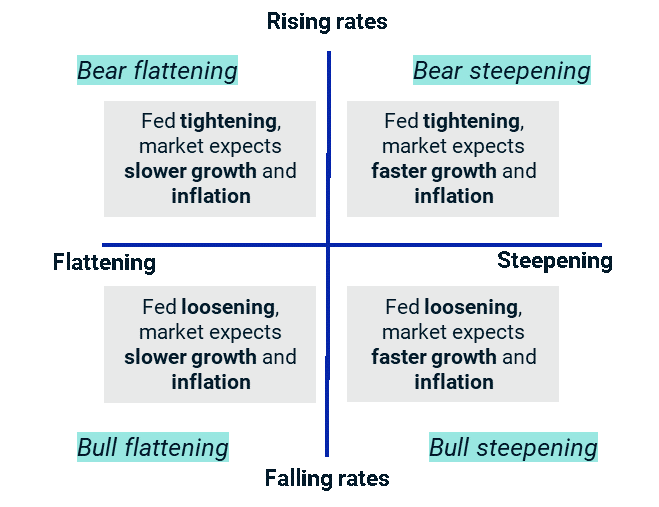
- 2/10 Spread: The difference in yield between the 2-year Treasury and the 10-year Treasury.
- Normal: 10y yield > 2y yield (the curve slopes up).
- Inverted: 2y yield > 10y yield. This is historically one of the most reliable predictors of an upcoming recession.
- Basis Trade: A strategy that exploits the price difference between a cash financial instrument (like a bond) and its derivative (like a futures contract).
- Credit Spread: The difference in yield between a risk-free government bond and a corporate bond of the same maturity. Widening spreads indicate the market is getting nervous about defaults.
The "Greeks" (Simplified)
If your fund uses options, LPs often get tripped up here:
- Delta: Sensitivity to the price of the underlying asset.
- Theta: The "time decay"—how much value the option loses every day it isn't exercised.
- Vega: Sensitivity to volatility. If the market gets "choppy," Vega-heavy portfolios see big swings.
Note to LPs: Macro investing is often about identifying when the "consensus" historical narrative (like the Plaza Accord) is being challenged by new geopolitical realities.